Inside GitHub’s new Git storage architecture
本文由「Inside GitHub’s new Git storage architecture」的公开内容整理,完整内容与后续更新请点击文末链接阅读原文。
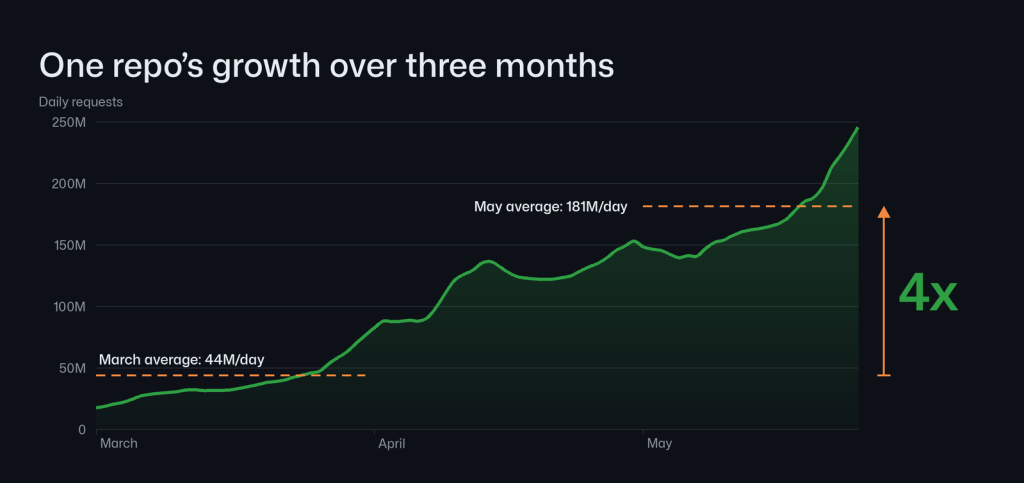
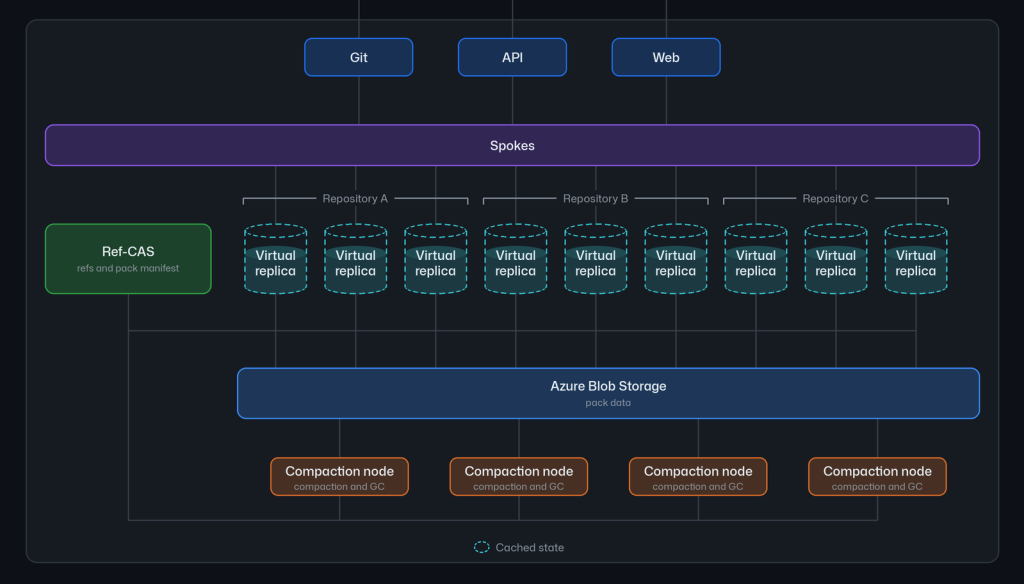
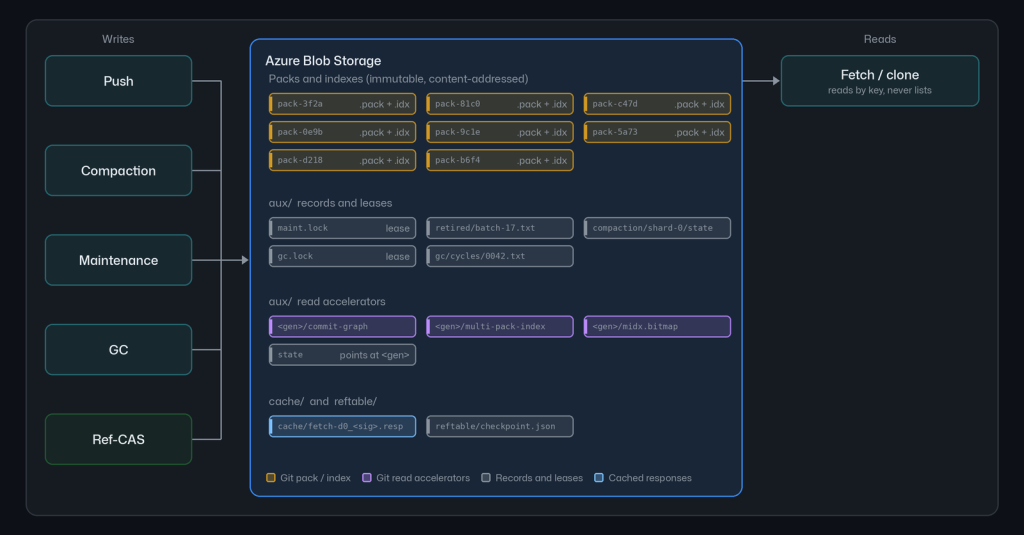
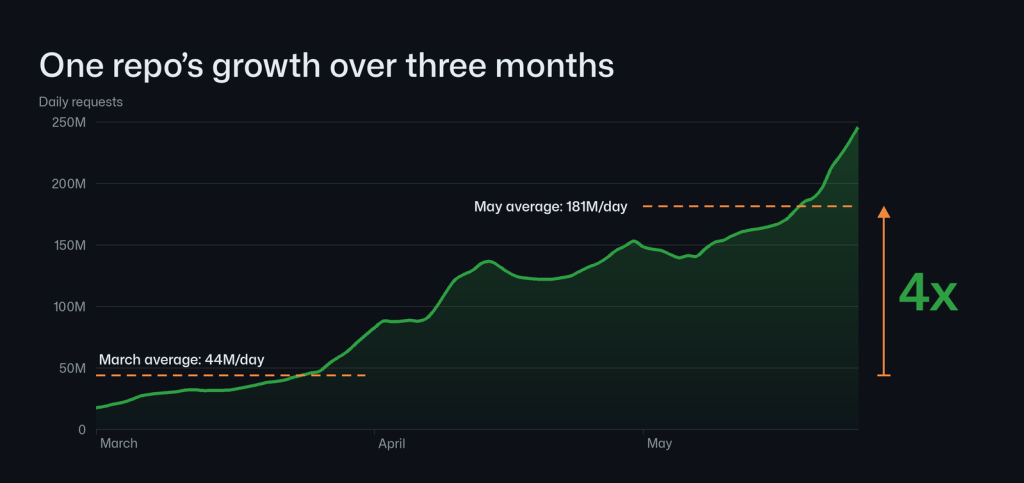
Karthik Raman & Brian Celenza November 5, 2026 | 16 minutes Share: Last week at GitHub Universe, we announced our new Git storage architecture, capable of handling thousands of writes per second with reads that scale on demand. Through internal testing, we’ve demonstrated the ability to support 5,000 concurrent agents working on a repository, sending 7,200 pushes per second to a repo, all while serving read traffic with consistently low latency. This new architecture is the foundation for GitHub to support agentic development for hundreds of millions of developers, and we’ve been building it underneath GitHub while it keeps running. Over the past year, agents changed what a busy repository looks like on GitHub. In our first post in this series, we laid out the two principles behind our next-generation Git storage architecture: minimize coordination, and decouple storage from compute. In our last post, we covered the bridge: moving 99.99999% of repositories into Azure, scoping the write quorum to individual references, and standing up virtual replicas backed by Azure Blob Storage. We also left off with an observation: very little of a write needs to be ordered. Git objects are immutable and named by their contents, meaning two writers can store them at the same time without agreeing on anything. The part of a push that needs agreement is the reference update, and a reference update is tiny in comparison. Virtual replicas were the first step toward building around that, and the means by which we onboard repositories to the new architecture. The rest of the architecture builds on that observation. Only reference updates need agreement. That lets the parts of Git infrastructure that used to be tightly coupled (storing data, serving requests, and maintaining repositories) scale independently. For developers, Git stays Git: they push, fetch, and branch the same way, with the same protections in place. Below, we walk through the requirements behind the design, follow a request through the system, and dive deep into two of its components. Building for agent scale We think about the scale of the GitHub platform along two axes: Horizontal scale is how many developers and agents can work across many repositories. Many of GitHub’s current approaches on this axis have been battle-tested over the years and are carried forward to the new architecture: partitioning of tenants across infrastructure, isolation and/or fairness enforcement of tenant traffic, and load-aware routing, to name a few. Vertical scale is how many developers and agents can work on one repository. As agents write more code, we expect individual repositories to get larger and busier, so most of our requirements came from the vertical axis. Today, the busiest repositories on GitHub.com receive at most dozens of writes in a single second, typically in short bursts. As more of that work shifts to agents running in parallel and around the clock, we expect those bursts to become a sustained rate within the next year. Each push leads to more reads: CI runs, deployment systems pull the new commit, and other agents fetch it for context. This read fan-out results in a large amplification effect on overall traffic that scales with writes. We’re already seeing this trend play out on repositories at the top of the curve. The chart below shows daily requests to one repository on GitHub from March to May, when its traffic grew about 4x. Its growth has continued on an exponential trajectory since then. We have to plan for a world where agent-driven development keeps accelerating at this speed. Instead of planning for the next increment, we set a target of at least two orders of magnitude more scale. For a single repository, that meant the new architecture needed to: Accept thousands of writes per second. Support multiple writer nodes. There are two reasons for this: Experience has taught us that indexing incoming packs and checking object connectivity are the most CPU-expensive parts of