GitHub availability report: October 2026
本文由「GitHub availability report: October 2026」的公开内容整理,完整内容与后续更新请点击文末链接阅读原文。
Jakub Oleksy·@jakuboleksy November 12, 2026 | 15 minutes Share: We continue to share monthly updates on the work behind GitHub’s availability and reliability. The short version of October: we added substantial independently scalable Azure capacity and removed several ways that failures could escalate. However, write outages, monitoring gaps during data migrations, and a regional network disruption reinforced the need for capacity growth to be paired with safer operations, stronger isolation, and validated regional recovery. As of November 9, 140 of 151 production services and 32 of 50 MySQL primaries were running in Azure Central US. Azure served 63% of migrated-service reads, 66% of monolith reads, and 52% of Git reads. We also completed a compute expansion across all nine Central US Kubernetes clusters, more than doubling capacity. That capacity is already carrying real growth. Migrated-service traffic has increased 82% since March, with Central US absorbing the growth beyond the highest weekly-average load previously served from our existing datacenter. This gives GitHub more room to grow without pushing the original environment beyond its prior operating range. We also made several targeted reliability improvements. Actions changes increased capacity for critical Azure control-plane requests. A separate NAT-gateway mitigation reduced usage by 85%;
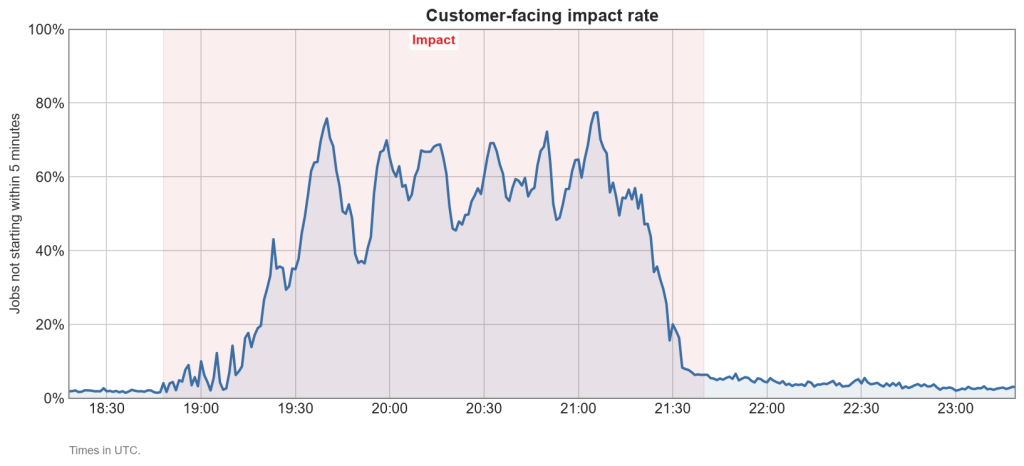
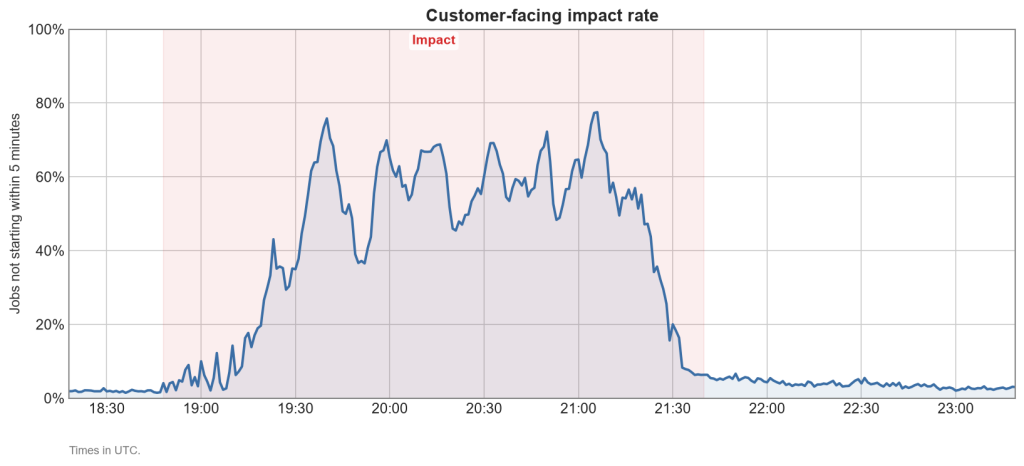
four production jobs failed during the change, compared with approximately 800 expected without the mitigation. Connection limits and other client improvements now also reduce the chance that a dependency interruption becomes a broader reconnect storm. We removed concentrated sources of database load as well. A high-traffic GitHub Actions endpoint handling more than 250 million requests per day moved to a more efficient service path, reducing peak database reads by 85%. Requiring at least three characters before searching repository topics reduced slow or terminated queries for that pattern by approximately 98%. Reliability was still not where it needed to be. The October 7 write outages exposed an unsafe interaction between database orchestration and production routing. An October 29 Azure network disruption affected all three Central US availability zones and at least 34,128 signed-in users. More details on these and other incidents follow. The East US 3 buildout is about one week behind plan. The next phase starts with its first validated traffic ramp in the first week of December, while we continue hardening migration safety, dependency isolation, and regional recovery. The principle remains the same: availability, then capacity, then features. October 05 19:11 UTC (lasting 3 hours and 38 minutes) Duration: approximately 3 hours and 45 minutes. Customers may have seen GitHub Actions jobs on GitHub-hosted runners stay queued much longer than usual, and some workflow runs failed to start. During the worst stretch, which lasted about 90 minutes, most jobs on GitHub-hosted runners did not start within five minutes. Impact eased as we failed over to healthy regions and added capacity. Self-hosted runners were not affected. GitHub Pages sites that build with actions were slow to update, though existing sites continued to serve normally. Some customers also saw errors in repository lists, licensing and billing pages, and some Copilot features. What went wrong and why?
Actions jobs stayed queued or failed to start because the service that assigns jobs to GitHub-hosted runners stopped working reliably. A partial networking failure on our cloud provider’s side disrupted some of the connections between one of our datacenter regions and the cloud-hosted databases that service depends on. Instead of failing fast, the service waited for those calls to time out. The waiting calls piled up until the service ran out of memory and restarted. Jobs then shifted to the same service in a healthy region, which did not have enough capacity for the extra demand and began failing too. At the same time